
Laser-Cut Screens: Privacy, Light, Airflow
Laser-cut screens divide space without blocking light or air. Learn how open-area ratio, pattern and thickness shape privacy, light and airflow in interiors.
Why use a laser-cut screen
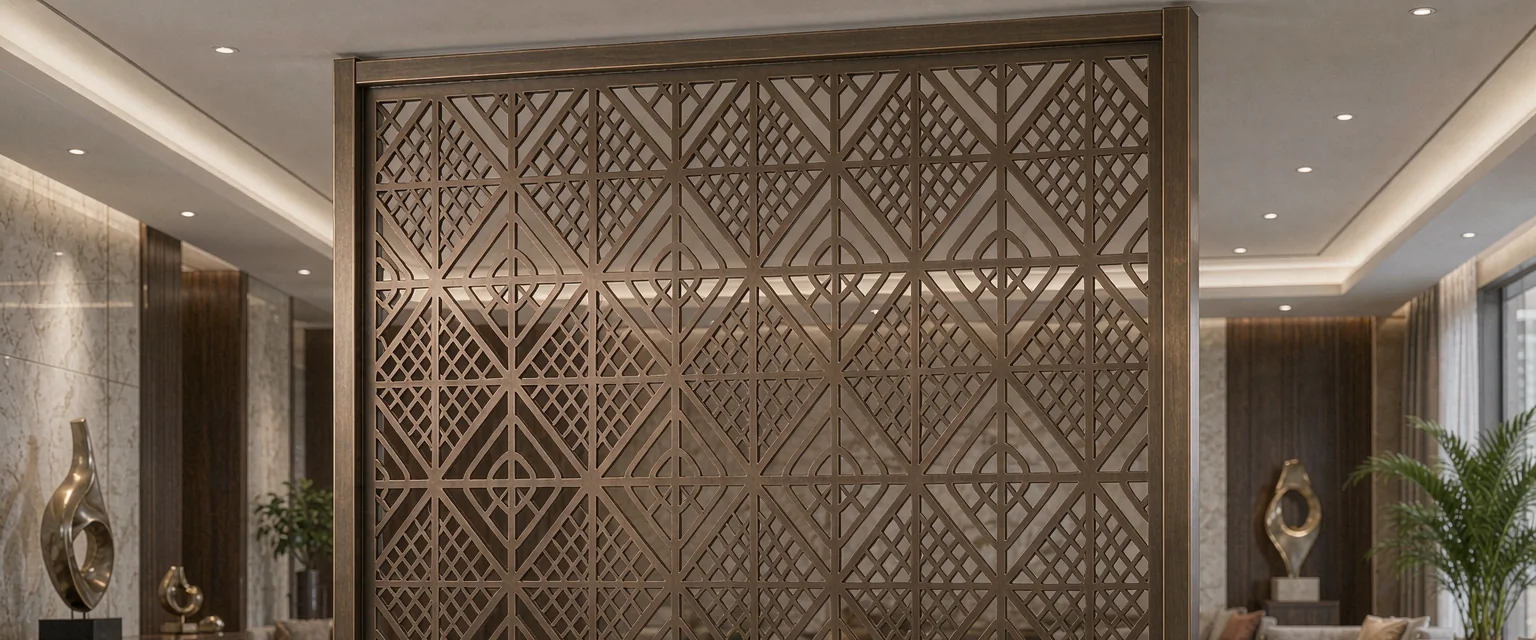
A laser-cut screen solves a common interior problem: how to separate zones without building a solid wall. In open-plan offices, restaurant dining areas, hotel lobbies and retail fitting rooms, a screen creates a visual boundary while still letting light pass and air circulate. That matters in Southeast Asia, where natural ventilation and daylight reduce cooling loads. Unlike a solid partition, a perforated panel keeps sightlines long and spaces connected, so a small room feels larger. It also gives designers a strong decorative element; the pattern itself becomes a feature wall. Screens are used as full-height dividers, balcony balustrade infills, reception backdrops, ceiling features and sliding doors. Because the cut is driven by a digital file, intricate geometric, floral or brand-specific motifs are as easy to repeat as simple grids. The result is a durable metal element that combines function and identity in one panel, with far less maintenance than timber or fabric alternatives in a humid climate.
Open-area ratio and pattern design
The single most important number in a screen is its open-area ratio: the percentage of the panel that is cut away. A low ratio around 20 to 30 percent gives strong privacy and blocks more sunlight but restricts airflow. A high ratio of 50 to 70 percent lets light and air move freely but reveals more of what is behind. For a restaurant divider, 35 to 50 percent is often a comfortable middle ground; for a balcony screen in a hot climate, lean higher. Pattern also changes perception. Fine, dense perforations read as a translucent veil from a distance, while large cut-outs read as a clear window. Random organic patterns disguise the view better than regular grids, which the eye can see straight through. Consider the viewing angle too: a panel that feels private when seen head-on may become transparent at a glance from the side. Ask for a small sample panel to hold up on site before finalising the pattern, and check how it looks both lit from the front and silhouetted against a bright window. This simple test prevents costly disappointment after installation.
Material, thickness and cut quality
Most decorative screens are cut from 304 stainless steel sheet in 1.5 to 3.0 mm. Thinner sheet lowers weight and cost but can warp across large panels, so add a frame or stiffening ribs; thicker sheet stays flat and feels more substantial in a high-touch public area. Choose 316 for coastal or poolside locations where humidity and salt are constant. After laser cutting, edges must be deburred and polished, because a raw cut edge is sharp and can corrode sooner than the rest of the panel. Ask how the supplier handles edge finishing; hand-finished edges are a sign of care. The laser itself should leave a clean, narrow kerf with minimal dross and no discolouration along the cut. For a patterned screen, the vector file is the master, so confirm ownership and keep a copy. Panels are often packed by part number for installation, which is essential when a large divider is split into sections. We produce screens to your drawings, with brushed or PVD finishes, and reply within 24 working hours.
Factory and project images are AI-generated illustrations, not photographs of a real facility or completed project.
Have a drawing ready?
Send it on WhatsApp or by email. Get grade, finish, MOQ and lead time back within 24 working hours.