
How to Inspect Stainless Panels on Arrival
Inspect stainless panels on arrival. Check grade marks, film, defects, dimensions and flatness before accepting delivery, and document damage for a claim.
Before you sign for delivery
The moment a crate arrives is your best chance to catch a problem while it is still easy to fix. Do not sign a clean delivery note before you have looked inside, or mark it as received subject to inspection if the carrier allows. Start by checking the crate against the packing list: the number of packages, the part numbers and the project reference. Photograph the outside of the crate before opening, especially if it shows signs of impact, water or rough handling. Then open each package carefully and keep the protective film in place until you are ready to inspect, because loose film can hide a surface defect until you remove it. Inspect in good, even light rather than in a dim warehouse corner, and avoid direct glare, which can mask fine scratches. If something is obviously wrong, stop and photograph it before moving panels around. A few minutes of attention at the loading bay is far cheaper than discovering a damaged panel after it has been cut or installed.
Grade marks and documents
Stainless steel is often ink-jet marked along the edge with the grade and the standard, such as 304 or 316. Check that this marking matches your order before you accept the material, and photograph it while the protective film is still on. If a sheet has no marking, do not assume the worst, but do ask for the mill certificate for that batch and compare the heat number delivered with the document. Keep the certificate with the delivery note and packing list in one project file. For coloured or PVD-coated panels, the base grade is usually hidden under the finish, so the certificate and your earlier approved sample are your only proof that the right material was used. If the job specified 316 for a coastal location and the paperwork says 201, stop the installation and raise it immediately. A wrong grade is not a cosmetic issue; in a humid or salty environment it will rust, and the cost of replacement after fitting is many times the cost of catching it at the loading bay.
Surface, dimensions and flatness
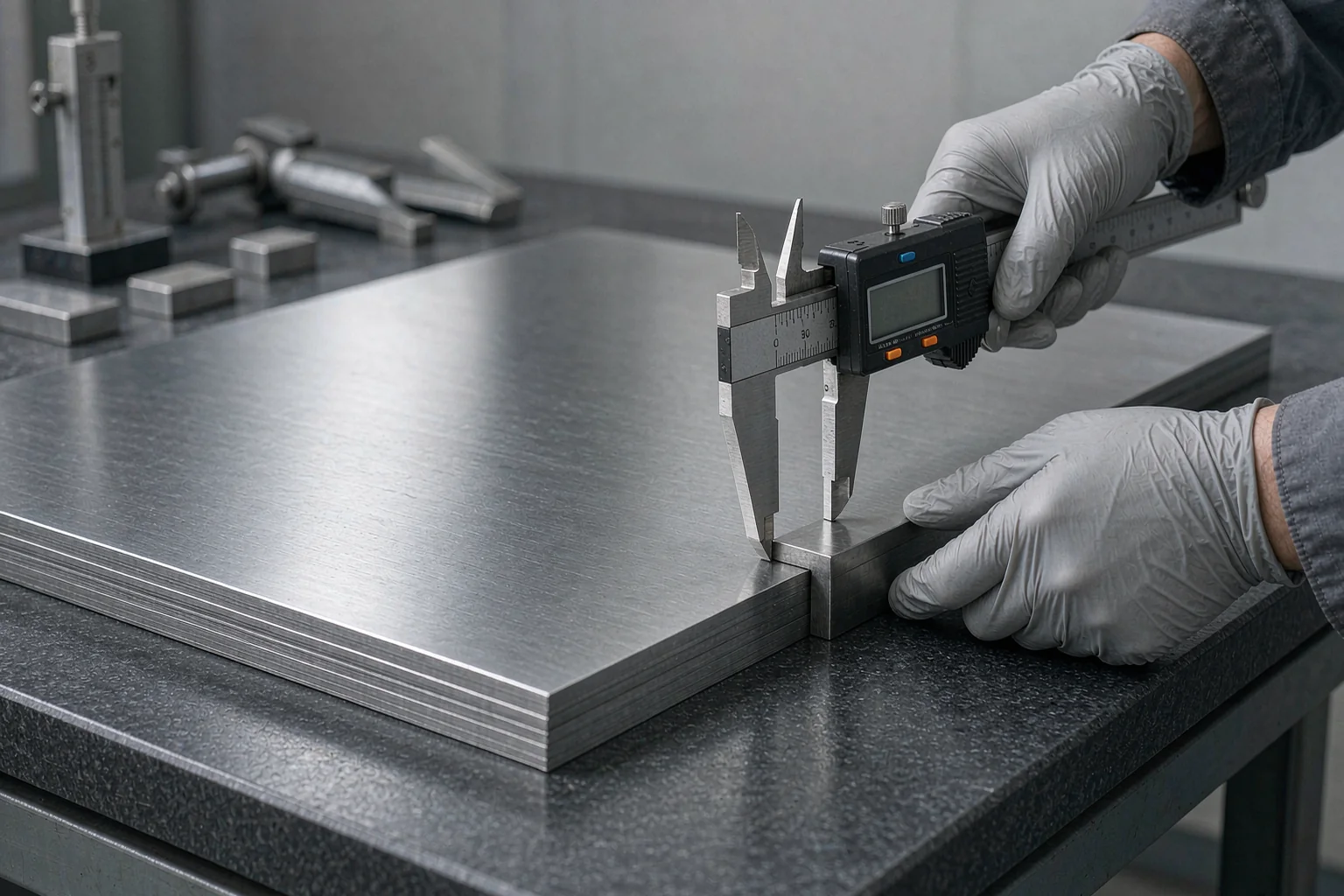
With the documents checked, remove a small section of film and examine the surface. Look for dents, deep scratches, roller marks, water stains and white rust, which appears as a powdery deposit in humid transit. On a brushed finish, rub a fingertip lightly along the grain; a defect you can feel is worse than one you can only see. Compare a coloured panel with your retained approved sample under the same light. Next, measure a few representative pieces rather than every panel: width, height, thickness with a caliper, and diagonal measurements to confirm the panel is square. Lay a straight edge across the face to check flatness, since a bowed panel can make a cabinet door or a cladding joint fail to close evenly. Slight protective-film adhesive residue is normal and usually removes with a mild solvent, but film that has baked onto a PVD surface in heat may be a real problem and should be photographed and reported.
Documenting problems and claims
If you find a defect, good records make the difference between a quick replacement and a long argument. Photograph the problem in close-up and again in context so its position on the panel is clear, including a part number or a ruler for scale. Note how many pieces are affected and record the crate number they came from. Write a short factual description the same day, because details fade quickly when several deliveries arrive together. Send the images to your supplier with the order reference and ask what they propose. Keep damaged pieces aside rather than installing them, and keep all packaging until the matter is settled, since the carrier may need to inspect it. Most issues are resolved faster when you show exactly what happened and propose a practical outcome, such as replacing two panels or sending a matching touch-up part. A calm, documented approach protects the schedule far better than an angry phone call with no evidence to support it.
Factory and project images are AI-generated illustrations, not photographs of a real facility or completed project.
Have a drawing ready?
Send it on WhatsApp or by email. Get grade, finish, MOQ and lead time back within 24 working hours.